

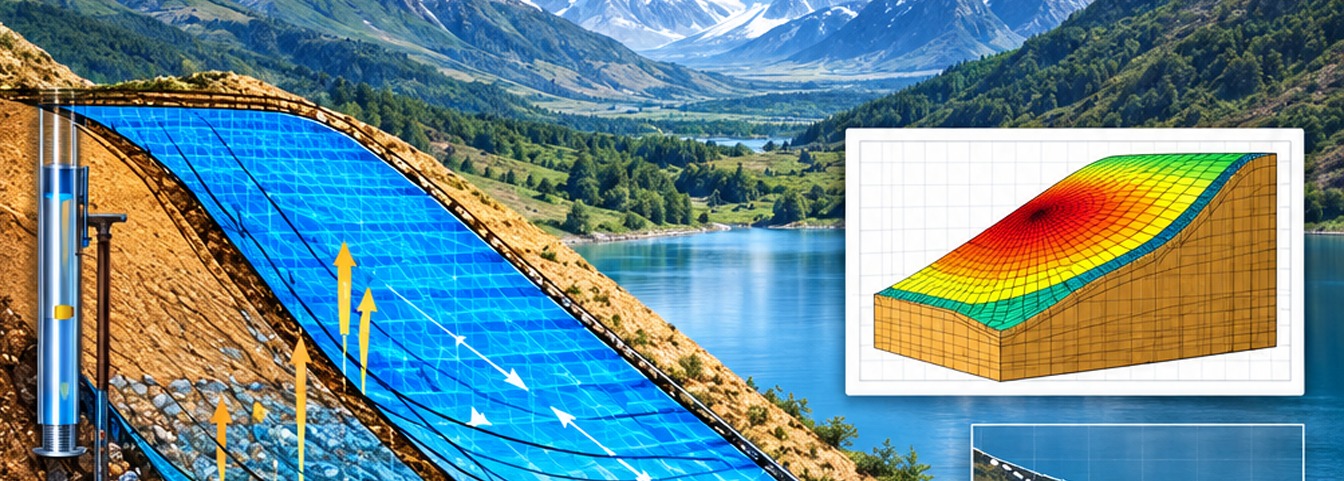
This study examines the influence of spatial variability of permeability on steady-state seepage flow and slope stability analysis. The research considers the uncertainty and heterogeneity of permeability properties within geotechnical materials and their effect on groundwater seepage and slope behaviour.
A commercially available finite-difference numerical code, FLAC 5.0, is used to model permeability as a spatially correlated, log-normally distributed random variable. The numerical modelling helps assess how variations in permeability influence seepage patterns and slope stability.
Key Areas
- Spatial Heterogeneity of Permeability
- Groundwater Seepage
- Slope Stability Analysis
- Uncertainty in Shear Strength
- Numerical Geotechnical Modelling
- Spatially Correlated Permeability
Numerical Analysis
The study uses FLAC 5.0 to investigate the effect of spatially variable permeability on the behaviour of a geotechnical slope. By representing permeability as a spatially correlated random variable, the analysis considers the natural variability of soil and rock properties rather than assuming a uniform permeability distribution.
The resulting seepage behaviour and its influence on slope stability are then evaluated to understand the relationship between permeability variability, groundwater flow, and slope performance.
Research Significance
Understanding spatial variability in permeability is important for realistic assessment of seepage and slope stability. Variations in permeability can influence groundwater flow paths and pore-water conditions, which may subsequently affect the stability characteristics of a slope.
The study provides a numerical framework for examining these interactions and contributes to a better understanding of seepage-related uncertainty and stability assessment in geotechnical engineering.
Publication
Engineering Geology, Volume 110, Issues 3–4, Pages 93–101